



 lexfamilia
Introduction:
Insider trading refers to the buying or selling of securities based on unpublished price-sensitive information (“UPSI”) that is not available to the general public. This practice typically involves company insiders such as executives, employees, or board members; or any other person who have access to confidential information about the company’s performance or prospects. By trading on this information, insiders can potentially reap significant profits, undermining the fairness of the market and putting the interests of uninformed investors at risk.
As insider trading poses serious ethical and legal issues, it has garnered increasing scrutiny from regulatory bodies, particularly the Securities and Exchange Board of India (“SEBI”). The challenge for insiders lies in their ability to resist the temptation to trade based on confidential information, especially when the potential for profit or loss avoidance is apparent. The complexity of insider trading continues to evolve, necessitating robust regulations and vigilant enforcement to maintain market integrity and protect investors.
Recently, the Regulator released a consultation paper dated July 29, 2024 wherein certain amendments were proposed to the SEBI (Prohibition of Insider Trading) Regulations, 2015, as amended (“PIT Regulations”). These amendments aim to enhance the regulatory framework by addressing certain gaps in the definition of “connected person” and “relative.” By expanding the categories of individuals and entities presumed to have access to UPSI, SEBI seeks to bolster its ability to prevent and investigate insider trading more effectively. The proposed amendments are twofold. Firstly, SEBI aims to align the definition of “connected person” with the “related party” definition under Section 2(76) of the Companies Act, 2013, as amended. This would extend the scope of connected persons to include a broader array of individuals and entities, such as those sharing a household or having material financial relationships with insiders. Secondly, SEBI intends to replace the term “immediate relative” with “relative,” in line with the broader definition under the Income Tax Act, 1961, thereby encompassing a wider group of family members presumed to have access to UPSI. These changes are designed to strengthen insider trading regulations without increasing compliance burdens. The proposed amendments to the PIT Regulations, while aimed at strengthening SEBI’s ability to combat insider trading, raise critical concerns about overreach, burden of proof, and the potential for unintended consequences. The expansion of the definition of connected persons and the reliance on a rebuttable presumption could lead to unfair outcomes, penalizing individuals who have no actual access to UPSI.
Below is the analysis of the SEBI | Final Order in the matter of alleged Insider Trading in the shares of Infosys Ltd. dated September 9, 2024 (“Order”). In the said matter concerning the alleged insider trading in the shares of Infosys Limited (“Company”), wherein SEBI placed reliance on the strength of evidence for determining the guilt of the alleged wrongdoers rather than relying on presumptions pertaining to the trades executed by them solely, based on their designation, familial connections and probable access to UPSI. This Order is thus a reminder that for creating a more robust and inquisitorial stance in curbing insider trading activities, reliance should be placed on the evidence brought on record and not merely rebuttable presumptions. Additionally, the Order states that regular communications, interactions or professional relationships with the Company will not be sufficient evidence if nothing is brought on record to show that the alleged wrongdoer had accessed UPSI during such interactions. In nutshell, multitude of other factors for examining contents of the conversation play an important role like duration between telephonic conversation and time when person came in possession of UPSI, relationship between alleged wrongdoers beyond professional relationship, monetary/non-monetary transactions, commercial or business transactions between parties and pecuniary gains incurred as a result of sharing UPSI that need to be taken into consideration.
Introduction:
A. FACTUAL BACKGROUND
- Preliminary examination by SEBI
- Certain allegations pertaining to insider trading in the scrip of the Company surfaced for the period around July 15, 2020. This period was close to the filing of the audited financial results of the Company for quarter ended on June 30, 2020 with the stock exchanges.
- SEBI conducted a preliminary examination to determine whether certain entities traded in the scrip of the Company while in possession of, or on the basis of UPSI in contravention to the SEBI Act, 1992 read with PIT Regulations.
- Entities in the alleged wrongdoing (“Noticee/(s)”): Pranshu Bhutra (“Noticee-1”), Amit Bhutra (“Noticee-2”), Bharath C Jain (“Noticee-3”), Capital One Partners (“Noticee-4”), Tesora Capital (“Noticee-5”), Manish C Jain (“Noticee-6”), Ankush Bhutra (“Noticee-7”), Venkata Subramaniyam V.V (“Noticee-8”), Sunil Kumar Dhareshwar (“Noticee-9”), New World Capital (“Noticee-10”), Optimus Capital (“Noticee-11”), Tattva Capital (“Noticee-12”), Akhil Jain (“Noticee-13”), Mahesh Chand Bhutra (“Noticee-14”), Aishwarya Ravishankar (“Noticee-15”) and Manish Bhutra (“Noticee-16”).
- It was observed in the SEBI’s preliminary examination that Noticee-1 to Noticee-8 had allegedly violated the provisions of PIT Regulations. Accordingly, an interim order dated May 31, 2021 (“IO”) was passed which was subsequently confirmed vide a confirmatory order dated September 15, 2021 (“CO”). Following this, SEBI conducted a detailed investigation into the alleged insider trading for the period between December 01, 2019 to November 30, 2020 (“Investigation Period/IP”) which covered the financial results of four quarters including December 31, 2019 (“First Quarter”), March 31, 2020 (“Second Quarter”), June 30, 2020 (“Third Quarter”)and September 30, 2020 (“Fourth Quarter”).
- Quashing of the interim order and confirmatory order passed by SEBI, as mentioned above, by the Securities Appellate Tribunal (“SAT”) – While the examination by SEBI was underway, Noticee-1 and Noticee- 8 preferred an appeal against the IO and CO passed by SEBI before the Vide an order dated April 25, 2022, the SAT quashed the IO and CO pertaining to Noticee1 and Noticee-8. The grounds on which SAT quashed the IO and CO are discussed later in this note.
- Relationship of Noticees: Noticees 1, 8 and 9 were employees of the Company and were expected to have access to UPSI basis professional relationship and position in the Rest of the Noticees were connected, directly or indirectly, with Noticee 1.
- Nature of UPSI: According to Structured Digital Database (“SDD”), the nature of UPSI allegedly available with the Noticees were revenue figures, profit margins, operating income, earnings per share, and other key financial metrics that were not disclosed to the public prior to the official release of the Company’s quarterly results.
- Duration of UPSI for financial quarters: For First Quarter, UPSI period commenced from December 30, 2019 and ended on January 10, 2020. For Second Quarter, UPSI period commenced from March 28, 2020 and ended on April 20, Further for Third Quarter, UPSI period commenced from June 29, 2020 and ended on July 15, 2020. Finally, for Fourth Quarter, UPSI period commenced from September 28, 2020 and ended on October 14, For each quarter mentioned above, the date of end of UPSI is the date of publication of the Company’s quarterly results.
- Identification of UPSI: SEBI established that the financial results of the Company for the quarters under investigation were classified as UPSI until they were publicly SEBI examined the SDD maintained by the Company, which detailed the flow of sensitive financial information within the Company. The UPSI periods for the quarters ended December 31, 2019, March 31, 2020, June 30, 2020, and September 30, 2020, were identified. During these periods, certain Noticees, including Noticee 1, allegedly communicated and traded based on UPSI.
- Connections and Communications Between Noticees: SEBI found that Noticee 1, as an employee of the Company, had access to UPSI either directly or through his communication with senior employees like Noticee 9 (Sunil Dhareshwar) and Noticee 8 (Venkatasubramaniyam V.V.), who were responsible for financial reporting. The investigation revealed a pattern of frequent phone calls between Noticee 1 and other Noticees during the UPSI periods. SEBI concluded that Noticee 1 passed on UPSI to connected entities, such as Noticee 2 (Amit Bhutra), who, in turn, communicated it to others, leading to coordinated trades in the scrip of the Company.
- Trading During UPSI Periods: SEBI observed that several entities, including Capital One Partners, Tesora Capital, and New World Capital, initiated trades in the shares of the Company shortly after key communications between Noticee 1 and other Noticees. SEBI found that these trades were executed while the entities were in possession of UPSI, violating insider trading The proximity of communication between the Noticees and their trading activities was considered indicative of coordinated insider trading.
- Circumstantial Evidence and Patterns: While SEBI admitted that direct evidence of insider trading (such as explicit communication of UPSI) was challenging to obtain, the circumstantial evidence—including the timing of phone calls, fund transfers, and the pattern of trading—strongly supported the allegation that UPSI was shared among the SEBI also applied a Delta analysis to assess the profitability of the trades, concluding that the insider trading activities generated unlawful gains.
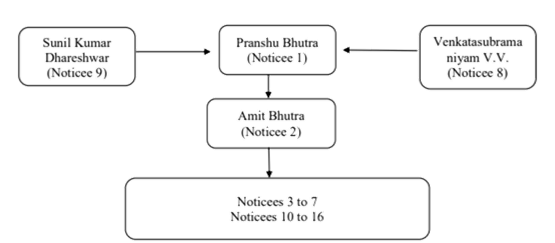
- Role of Key Individuals: SEBI particularly focused on the role of Noticee 9 (Sunil Dhareshwar) and Noticee 8 (Venkatasubramaniyam V.) as key sources of UPSI, due to their positions in the company’s financial reporting structure. Noticee 1 was identified as the intermediary who facilitated the transfer of UPSI to other entities.
- Trading During the UPSI Period: It was observed that Noticees 2, 4, 5, 10, 11, 12, and 13 traded in the scrip of the Company during periods when UPSI was available. Additionally, Noticee 1 was accused of not only having independent access to UPSI but also receiving it from Noticees 8 and 9, who were insiders, and subsequently passing the UPSI to these seven noticees for trading purposes.
- First Quarter Financial Results (Dec 31, 2019):
- UPSI Period: From December 30, 2019, to January 10,
- Noticee-9 had access to crucial information such as revenue, margin, and tax details by January 6,
- Multiple phone calls were exchanged between Noticee 1 and other Noticees during this period, allegedly to communicate UPSI.
- Noticee 9 communicated the UPSI to Noticee 1, who then passed it on to other Noticees who traded from January 7, 2020 onwards.
- Third Quarter Financial Results (June 30, 2020):
- UPSI Period: From June 29, 2020, to July 29,
- Noticee 8 allegedly communicated UPSI to Noticee 1, who further communicated it to Noticee
- Noticee 1 and Noticee 8 had an increased frequency of calls during June-July 2020, which culminated in trading by the entities beginning July 10, 2020.
- Fourth Quarter Financial Results (Sept 30, 2020):
- UPSI Period: From September 28, 2020, to October 14, 2020.
- The SCN alleged that Noticee 9 communicated UPSI related to the fourth quarter to Noticee 1, who then passed it on to other Noticees. Trading commenced from October 12, 2020.
- Generation of unlawful gains: Several Noticees were alleged to have generated unlawful gains from insider trading. Noticee-2 earned ₹8,18,400 and ₹1,64,232, while Noticee-4 generated ₹29,122,650.96. Noticee-5 earned₹2,385,413.33, and Noticee-10 made ₹10,452,401. Noticee-11 and Noticee-12 gained ₹2,10,360 and ₹14,174,646.67, respectively. The entities involved in these trades, including Noticees 1, 2, 3, 8, 9, and others, were collectively held responsible for joint and several impounding and disgorgement of these profits due to their alleged involvement in the insider trading activities.
- Deriving from the allegations of the SCN, the Regulator vide pictoral representation depicted the alleged flow of UPSI in the case at hand. The same can be accessed via link to the Order, but for ease of reference, the same has been reproduced below:
- Reply of Noticee-1: In response to the allegations made in the SCN, Noticee-1 made the following submissions:
- Professional Role and Limited Access: Noticee 1 emphasized that during the IP, he was employed in the Employment Law team at the Company, advising on issues related to employment law for the Asia Pacific region. He argued that his role did not require interaction with teams involved in the financial results or other sensitive financial data, which would have allowed him access to UPSI. Therefore, he claimed it was highly improbable that he could have obtained UPSI.
- No Direct Evidence of UPSI Possession: Noticee 1 contended that SEBI failed to provide direct evidence showing that he had access to or passed on UPSI to others. He stated that the allegations were based on circumstantial evidence (such as phone calls with other noticees) and speculative assumptions rather than concrete He highlighted that the SDD maintained by the Company, which records individuals with access to UPSI, did not list his name.
- Nature of Communication: The defense pointed out that the phone calls with other Noticees, particularly Noticee 2, were related to personal matters and not to Infosys’ He noted that his communication with these individuals occurred throughout the year, and it was not limited to the periods preceding the release of financial results.
- Role in the Company’s Hierarchy: Noticee 1 stressed that he was a mid-level employee among 30,000 other employees at a similar He argued that his designation did not place him in a position to access sensitive financial information, refuting SEBI’s assumption that he could have accessed UPSI based on his position alone.
- Interaction with Senior Management: The defense addressed the specific allegation that Noticee 1’s interaction with senior management and attendance at certain meetings meant that he had access to He explained that his participation in those meetings was strictly limited to employment law issues (e.g., updates on labor codes) and did not involve discussions about the company’s financial performance or results.
- Involvement of Noticee-1 in partnership with Genesys (“Genesys Deal”): Reference was made in SCN pertaining to the 5-year partnership of the Company with Genesys which was announced on August 27,2020. Noticee-1 submitted that the Genesys Deal implicated employment law perspective because of which Noticee-1 was looped in communication vide email dated July 07, 2020 providing legal assistance on employment specific aspects. This involvement had no bearing on his ability to access UPSI.
- No Transmission of UPSI: Noticee 1 asserted that there was no basis for the allegation that he transmitted UPSI to Noticee 2 (Amit Bhutra). He argued that the phone calls cited by SEBI to support this claim occurred before Noticee 9 (Sunil Kumar Dhareshwar) had access to UPSI, making it impossible for him to have obtained or shared the information as alleged.
- Baseless Allegations of Communication with Noticees 8 and 9: Noticee 1 challenged the allegation that he procured UPSI from Noticees 8 and 9 and passed it on to He clarified that his interactions with these noticees were purely related to employment matters and had nothing to do with the company’s financial performance.
- Misinterpretation of Professional Duties: SEBI’s reliance on Noticee 1’s role in handling employment law matters (including contracts, terminations, and litigation) was called out as a misinterpretation of his duties. He explained that his work had no connection with the company’s financial operations or the preparation of financial results.
- Replies filed by other Noticees:
- Rest of the Noticees collectively denied the allegations of insider trading, asserting that SEBI lacked direct evidence proving their involvement in the sharing or use of UPSI. Noticee 2, who was closely linked to Noticee 1, argued that their communications were personal in nature, not related to insider information, and that SEBI failed to provide evidence of him acting on Similarly, Noticees 3, 4, and 5 contended that their trades were part of routine business or personal investment strategies, unrelated to any insider information. They maintained that SEBI’s case was based on circumstantial evidence without concrete proof of UPSI exchange.
- Noticees 8 and 9, who were senior employees of Infosys, denied having shared any UPSI with Noticee 1 or other Noticees. They clarified that their interactions with Noticee 1 were strictly professional, dealing with employment law matters, and did not involve discussions related to the company’s financial results. Other entities such as Noticees 10, 11, 12, and 13 also argued that their trading activities were independent and coincidental, with no involvement in insider trading. Across the board, the Noticees emphasized the lack of evidence and maintained that their trades were executed based on market analysis, not insider information.
- Pertaining to whether Noticee-1 because of his professional relationship with the Company had independent access to UPSI:
- SEBI held that the material available on record was insufficient to suggest that Noticee-1 because of his professional relationship with the Company had independent access to UPSI due to following reasons:
- SEBI observed that the name of Noticee-1 was not mentioned in the list of designated persons of the Company identified in terms of Regulation 9(4) read with Regulation 9(4)(2)(a) of PIT Regulations. It was also not mentioned in the list of employees having access to UPSI, whose names appeared in SDD.
- The fact that Noticee-1 communicated with the employees of the Company and employees of Deloittee who had access to UPSI was not a conclusive proof that Noticee-1 was in a position where he could be expected to access UPSI. Further, employees who had access to UPSI need not necessarily share UPSI with those with whom they communicated on regular basis.
- If Noticee-1 held an important position that paved way for him to access UPSI, the name should have reflected in the list of designated The fact that Noticee-1 was neither a designated person, nor his name reflected in SDD speaks volumes of the fact that he had no access to UPSI. Additionally, SCN failed to adduce any evidence to substantiate the claim that UPSI was shared with Noticee-1 in the ordinary course of business while he performed his official duties.
- SEBI held that the material available on record was insufficient to suggest that Noticee-1 because of his professional relationship with the Company had independent access to UPSI due to following reasons:
- Pertaining to whether Noticee-1 procured UPSI for First Quarter and Fourth Quarter from Noticee-9
- Pertaining to whether Noticee-1 procured UPSI for First Quarter and Fourth Quarter from Noticee-9
- Noticee-1 and Noticee- 9 had regular telephonic conversations much before the latter came in possession of UPSI. Due to regular conversations between both, it cannot be concluded only on the basis of conversations after Noticee-9 came in possession of UPSI that Noticee-9 communicated UPSI to Noticee-
- There was no record to suggest that Noticee-1 and Noticee-9 shared relationship beyond the official
- There was no record of personal dealing whether monetary, non- monetary, commercial or business transactions between both that could suggest direct quid pro quo.
- There was absence of any record depicting pecuniary gains that Noticee-9 made by sharing UPSI.
- Further, Noticee-1 had provided copies of emails as evidence of the context in which the telephonic conversations had taken place with the Noticee-9, after Noticee-9 came in possession of UPSI for the concerned two quarters.
- Pertaining to whether Noticee-1 procured UPSI for First Quarter and Fourth Quarter from Noticee-9
- Pertaining to whether Noticee-1 procured UPSI for Third Quarter from Noticee-8
- SEBI held that the allegation held no water without substantiation vide additional evidence against Noticee-1 and Noticee-8 due to the following reasons:
- SCN failed to bring forth any circumstantial evidence which could show that Noticee-9 communicated UPSI to Noticee-8. Additional evidence indicating indirect reporting by Noticee-8 to Noticee-9 were insufficient to establish that Noticee-8 had access to UPSI which he passed on to Noticee-1.
- The non-availability of WhastApp call logs and messages on the phones of Noticee-1 and Noticee-8 for the period from December 01, 2019 to June 30, 2020 were insufficient to prove that Noticee-8 had access to Further, no adverse inference could be taken against Noticee-1 and Noticee-8 since SAT already quashed both, the IO and CO against the Noticees on the ground that observations made in IO were sufficiently explained by them.
- SEBI held that the allegation held no water without substantiation vide additional evidence against Noticee-1 and Noticee-8 due to the following reasons:
G. Order
- SEBI directed that the restraint imposed on Noticee-2 to Noticee-7 vide the IO and CO be vacated with immediate effect. Further, the Regulator held that the proceedings against Noticee-1 to Noticee-16 stood disposed off without
- SEBI directed that the amounts, if any, impounded from Noticee-2 to Noticee-7 and deposited in escrow accounts pursuant to the directions of IO and CO should be Directions were issued to the concerned banks for the initiation of the same.
Legal Concepts
Regulation 2(1)(d)(i) of PIT Regulations:
“connected person” means
- any person who is or has during the six months prior to the concerned act been associated with a company, directly or in
- directly, in any capacity including by reason of frequent communication with its officers or by being in any contractual, fiduciary or employment relationship or by being a director, officer or an employee of the company or holds any position including a professional or business relationship between whether temporary or permanent, that allows such person, directly or indirectly, access to unpublished price sensitive information or is reasonably expected to allow such access.
“insider” means any person who is:
or
NOTE:
Since “generally available information” is defined, it is intended that anyone in possession of or having access to unpublished price sensitive information should be considered an “insider” regardless of how one came in possession of or had access to such information. Various circumstances are provided for such a person to demonstrate that he has not indulged in insider trading. Therefore, this definition is intended to bring within its reach any person who is in receipt of or has access to unpublished price sensitive information. The onus of showing that a certain person was in possession of or had access to unpublished price sensitive information at the time of trading would, therefore, be on the person leveling the charge after which the person who has traded when in possession of or having access to unpublished price sensitive information may demonstrate that he was not in such possession or that he has not traded or he could not access or that his trading when in possession of such information was squarely covered by the exonerating circumstances.
Regulation 9(4) of PIT Regulations:
The extracts of the regulation along with the rationale are explained below:
Rationale: The provision aims to protect market integrity by reducing the risk of insider trading. Individuals who are covered by the code of conduct are those who are likely to have direct or indirect access to UPSI. The goal is to prevent these individuals from using or sharing that information to trade securities or tip others off before the information becomes public. By targeting employees based on their functional roles, rather than just seniority, the regulation closes potential loopholes where lower-level employees could access UPSI and engage in insider trading. Extending the provisions to cover employees of material subsidiaries reflects the understanding that subsidiaries may be engaged in significant business activities that affect the parent company’s stock price. Material subsidiaries are typically those whose financials have a considerable impact on the listed company’s consolidated financials. Employees in these subsidiaries, even if they do not work for the parent company directly, they may still have access to UPSI related to the group’s overall performance, making them important to include under the code of conduct.
Regulation 9A (2)(a) of PIT Regulations:
The extracts of the regulation along with the rationale are explained below:
Rationale: The primary goal of identifying employees with access to UPSI as designated persons is to prevent insider trading. UPSI can significantly affect a company’s stock price if it becomes public, and individuals who have access to this information before it is made public could use it to gain an unfair advantage by trading securities or passing information to others. By identifying these employees, companies can ensure that they are bound by rules that restrict their ability to trade securities or disclose information, thus preventing illegal or unethical behavior.
Section 12A (e) of SEBI Act, 1992:
The extracts of the regulation along with the rationale are explained below:
“…
No person shall directly or indirectly deal in securities while in possession of material or non-public information or communicate such material or non-public information to any other person, in a manner which is in contravention of the provisions of this Act or the rules or the regulations made thereunder
…”
Rationale: Many insiders, such as directors, executives, employees, and others in privileged positions, have a fiduciary duty to act in the best interest of the company and its shareholders. Using non-public material information for personal gain violates this fiduciary duty, eroding trust within the company and with shareholders. This provision reinforces the ethical obligation of insiders to handle sensitive information responsibly and in the interest of all shareholders, rather than for personal benefit.
Regulations 3(1) of PIT Regulations:
The extracts of the regulation along with the rationale are explained below:
“…
No insider shall communicate, provide, or allow access to any unpublished price sensitive information, relating to a company or securities listed or proposed to be listed, to any person including other insiders except where such communication is in furtherance of legitimate purposes, performance of duties or discharge of legal obligations.
…”
Rationale: Investor confidence is critical to the functioning of financial markets. If investors believe that certain individuals have unfair access to inside information and can profit at their expense, they may lose confidence in the fairness of the markets. This can lead to reduced participation and lower liquidity, making it harder for companies to raise capital and for markets to function effectively. By prohibiting trading based on non-public information, regulators foster an environment where investors trust that markets are governed by rules that apply equally to everyone.
Regulation 3(2) of the PIT Regulations:
The extracts of the regulation along with the rationale are explained below:
“…
No person shall procure from or cause the communication by any insider of unpublished price sensitive information, relating to a company or securities listed or proposed to be listed, except in furtherance of legitimate purposes, performance of duties or discharge of legal obligations
…”
Rationale: The provision prohibits the communication of material non-public information to others. This is crucial because it prevents insiders from tipping off friends, family members, or business associates who could use that information to trade. Without this provision, insiders could bypass the law by simply passing the information to others who could trade on their behalf. Preventing information leakage helps to ensure that confidential company information remains secure and is not misused to gain an advantage in the market.
Sections 12A (d) of SEBI Act, 1992:
The extracts of the regulation along with the rationale are explained below:
“…
No person shall directly or indirectly engage in insider trading
…”
Rationale: Insider trading disproportionately affects small and retail investors, who do not have access to the same level of information as company insiders or institutional investors. If insiders are allowed to trade on confidential information, it puts retail investors at a severe disadvantage, leading to unfair outcomes. By enforcing this provision, regulators aim to protect the interests of small investors, promoting fair competition and confidence in the markets.
Sections 12A (e) of SEBI Act, 1992:
The extracts of the regulation along with the rationale are explained below:
“…
No person shall directly or indirectly deal in securities while in possession of material or non-public information or communicate such material or non-public information to any other person, in a manner which is in contravention of the provisions of this Act or the rules or the regulations made thereunder
…”
Regulation 4(1) of PIT Regulations:
The extracts of the regulation along with the rationale are explained below:
“…
No insider shall trade in securities that are listed or proposed to be listed on a stock exchange when in possession of unpublished price sensitive information
…”
Rationale: Material non-public information can significantly impact stock prices, and insiders trading on this information could lead to market manipulation. For example, if an insider knows that the company is about to release positive earnings or announce a merger, they could buy shares before the public announcement, benefiting from the price increase once the news is made public. By prohibiting trading on UPSI, the rule helps to prevent artificial price movements and market manipulation, ensuring that stock prices are determined by public information rather than insider knowledge.
The Securities Appellate Tribunal (“SAT”) quashed the interim order dated May 31, 2021, and the confirmatory order dated September 15, 2021, passed by SEBI in the case of Pranshu Bhutra (Noticee 1) and Venkatasubramaniyam V. V. (Noticee 8). SAT’s decision to quash these orders was based on several key grounds, which are detailed below:
- Pranshu Bhutra was employed in the eployment law team at Infosys and dealt with employment law- related matters in the Asia-Pacific region. SAT emphasized that SEBI had not provided sufficient evidence that his professional role gave him access to the financial information that constituted
- SEBI’s case was built on circumstantial evidence, such as communication patterns (calls and emails) between Pranshu and other noticees (particularly Amit Bhutra), but SAT held that SEBI had not established that these communications involved UPSI.
- SAT ruled that simply being in communication with others who may have had access to UPSI was not enough to infer guilt without clear evidence showing that UPSI was shared or used for trading.
Infosys maintained an SDD, which recorded all individuals who had access to UPSI on a need-to-know basis. SAT noted that Pranshu Bhutra’s name did not appear in the SDD, which meant he was not formally identified as someone with access to UPSI within Infosys.
- SAT held that SEBI failed to explain why Pranshu, who was not listed in the SDD, would have had access to such sensitive information. This weakened SEBI’s argument that he had access to UPSI and passed it on to others.
SAT highlighted that mere communication between individuals—even if frequent or during UPSI periods— does not amount to proof of insider trading. SEBI had based its case on the fact that Pranshu Bhutra was in regular communication with individuals like Amit Bhutra, who traded during UPSI periods. However, SEBI did not establish that these communications involved the exchange of UPSI.
- Frequent communications were attributed to personal and familial relationships (Pranshu and Amit were second cousins). SAT pointed out that these communications could have been for personal reasons and did not necessarily relate to trading on UPSI.
Another key issue raised by SAT was SEBI’s inability to show that the information allegedly communicated by Pranshu was used for trading.
- SAT emphasized that SEBI did not demonstrate that the trades executed by the noticees were based on UPSI. While SEBI pointed to circumstantial evidence, such as timing of trades and phone calls, SAT held that concrete proof of the use of UPSI was required for a finding of insider trading.
- SAT noted that SEBI relied heavily on assumptions and probabilities, without establishing how the UPSI was passed from Pranshu to other individuals. There was no clear flow of information or proof showing that any of the alleged insiders acted on the basis of UPSI provided by Pranshu.
SEBI had invoked its powers under Sections 11 and 11B of the SEBI Act to issue the interim order against the noticees. SAT noted that SEBI had not provided sufficient justification for taking such urgent action without adequate evidence.
- SAT held that SEBI should have conducted a more thorough investigation before passing the interim order, especially since the investigation did not reveal any immediate harm or threat to the securities market that would justify the imposition of such drastic measures without more concrete proof.
Based on the above grounds, SAT concluded that the interim and confirmatory orders were unsustainable due to the lack of direct evidence, inadequate justification for urgent action, and reliance on circumstantial evidence without demonstrating a clear link between the noticees and insider trading activities.
- SAT ordered the quashing of both the interim and confirmatory orders, releasing the restrictions placed on Pranshu Bhutra and Venkatasubramaniyam V. V. by SEBI.